
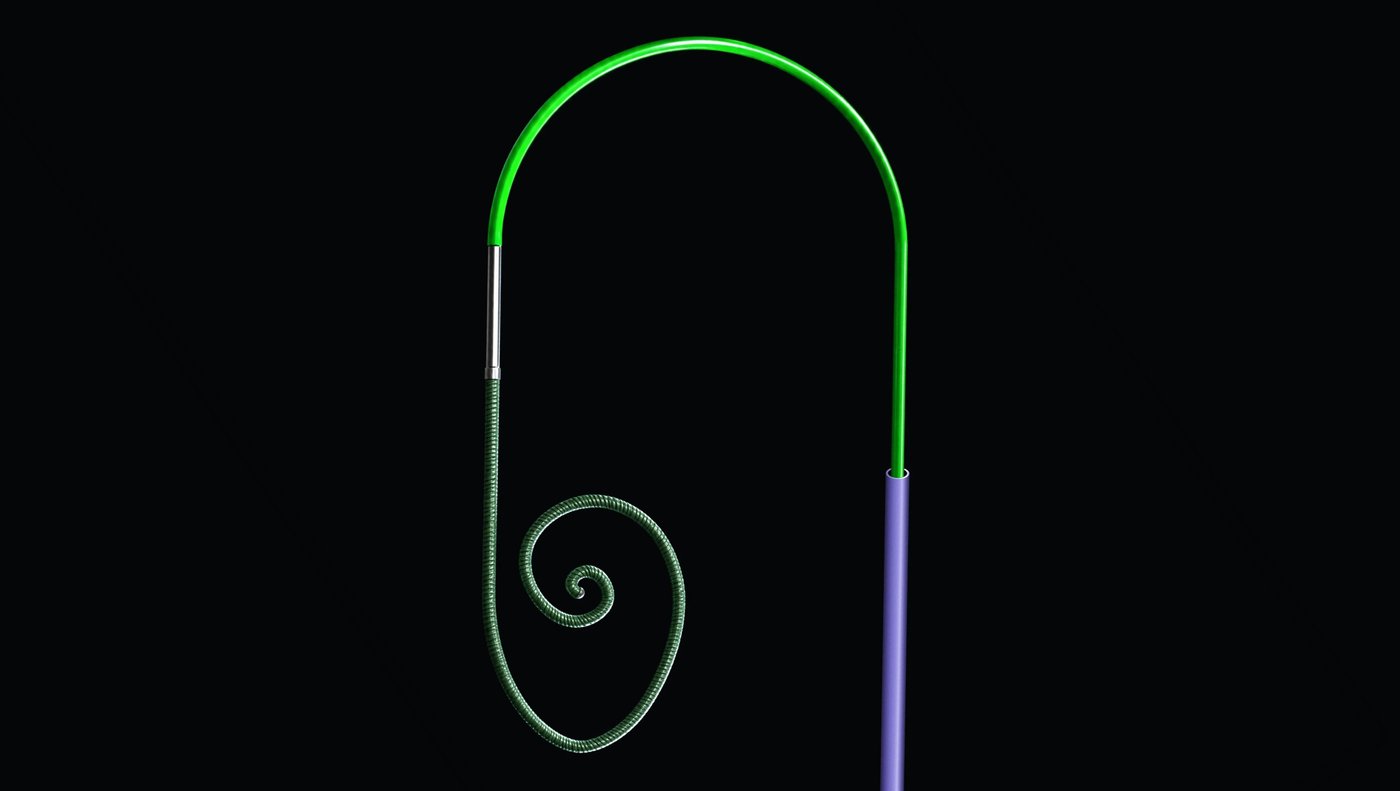
Concept render of the Schwartz™ Wire: a smooth bright-green shaft rising out of a slim lavender sheath into one large arch, a short steel band, then a sage-green coil-wound section ending in a large egg-shaped open spiral with a small inner curl

Schwartz™ Wire · TAVR guidewire · Prototype · Patent pending

Strong rail support, designed for gentle
apical contact.

Its preshaped curve is designed to absorb force at the aortic arch, so less force travels down the wire and the spiral tip can rest atraumatically at the apex.

Meetings by video or in person

01 — The tradeoff

The stiff-wire tradeoff.

Now, the Schwartz™ Wire.

AorticarchAscending aortaDescending aorta
  1. 01The wire runs over the aortic arch and parks in the LV, ready to support the delivery system.
  2. 02The delivery system advances. The rail takes the load.
  3. 03A conventional wire turns at one point on the arch, so load can concentrate there and at the apex.
Rail support0
Apical force0

Illustrative · relative index

Simplified illustration of the heart, not an accurate depiction of anatomy. Not clinical or bench data.

02 — The design answer

Designed to distribute the load across the arch.

Now, the Schwartz™ Wire.

AorticarchAscending aortaDescending aorta
  1. 01The large curve is designed to sit atop the aortic arch, adding stability to the rail.
  2. 02The delivery system advances. The arch curve is designed to absorb the push before it reaches the ventricle.
  3. 03With less force passed down the wire, the spiral tip is designed to rest atraumatically at the apex.
Rail support0
Apical force0

Illustrative · relative index

Simplified illustration of the heart, not an accurate depiction of anatomy. Not clinical or bench data.

03 — See the placement

From the arch to the apex.

Watch the Schwartz™ Wire take its intended position: over the aortic arch, through the valve, and into a spiral tip in the left ventricle.

Concept animation
Concept animation. Not clinical or bench data.

04 — Design goals

Can a wire provide rigidity, offer stability, and be gentle at the same time?

Six design goals,
one system.

Six things the Schwartz™ Wire is engineered to do.

01 · Platform

Rail support for delivery

A stiff, stable rail designed to support bulky delivery systems across the arch, native valve and annulus, including tortuous or calcified anatomy. Stiffness is designed to sit in an optimal balance with atraumatic anchoring.

Source: Draht Medical internal bench testing · Relative values · Not clinical data
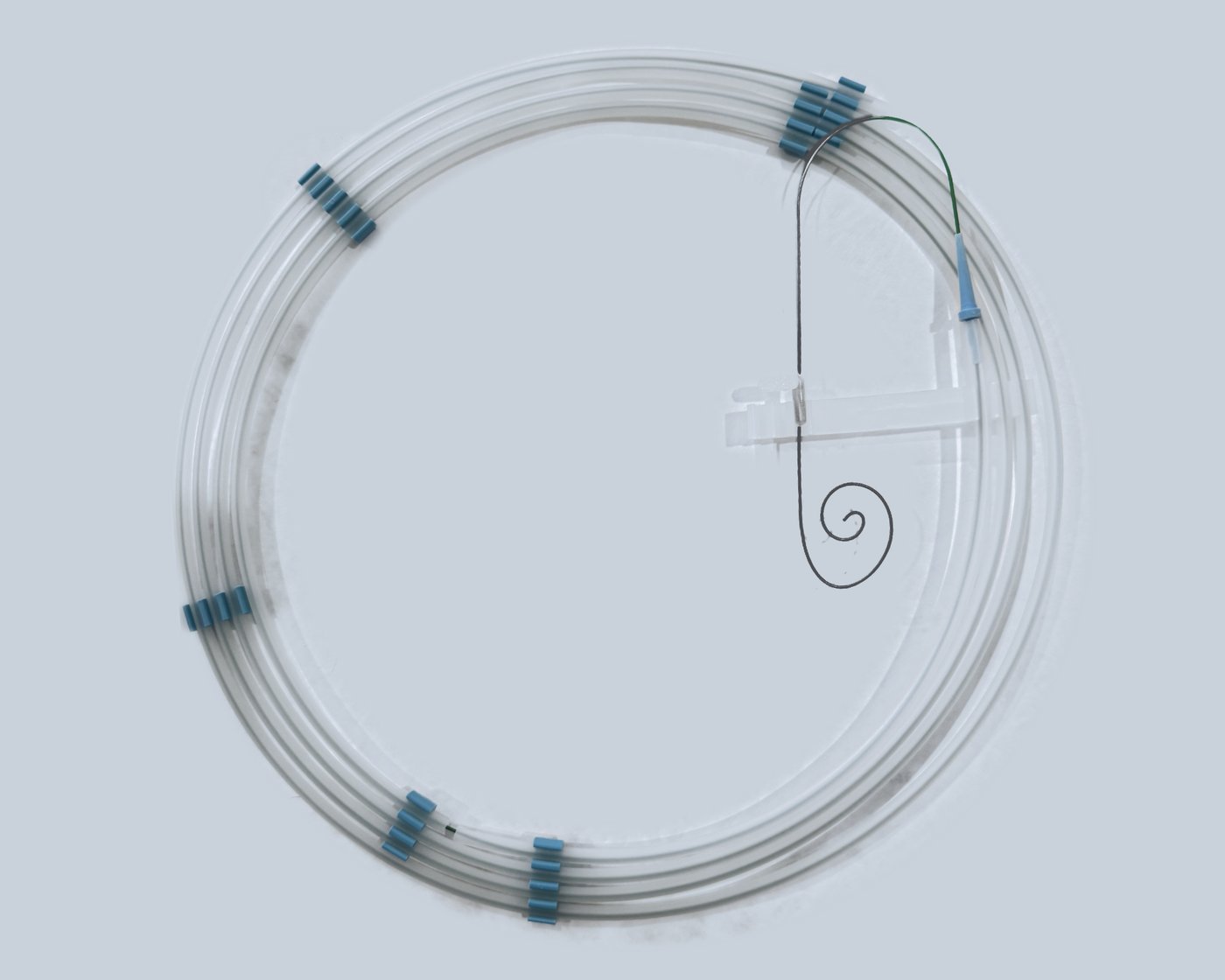
The Schwartz™ Wire concept prototype coiled in its clear dispenser hoop with blue clips. The exposed wire rises from the blue hub over a green-coated arch, runs straight down and ends in a small spiral tip. Concept renderings. Not the final device.
02 · Stability

Positional stability

Designed to hold its shape in the LV through advancement, positioning, deployment and recapture, so the wire stays where it was placed.

03 · Anchoring

Atraumatic anchoring

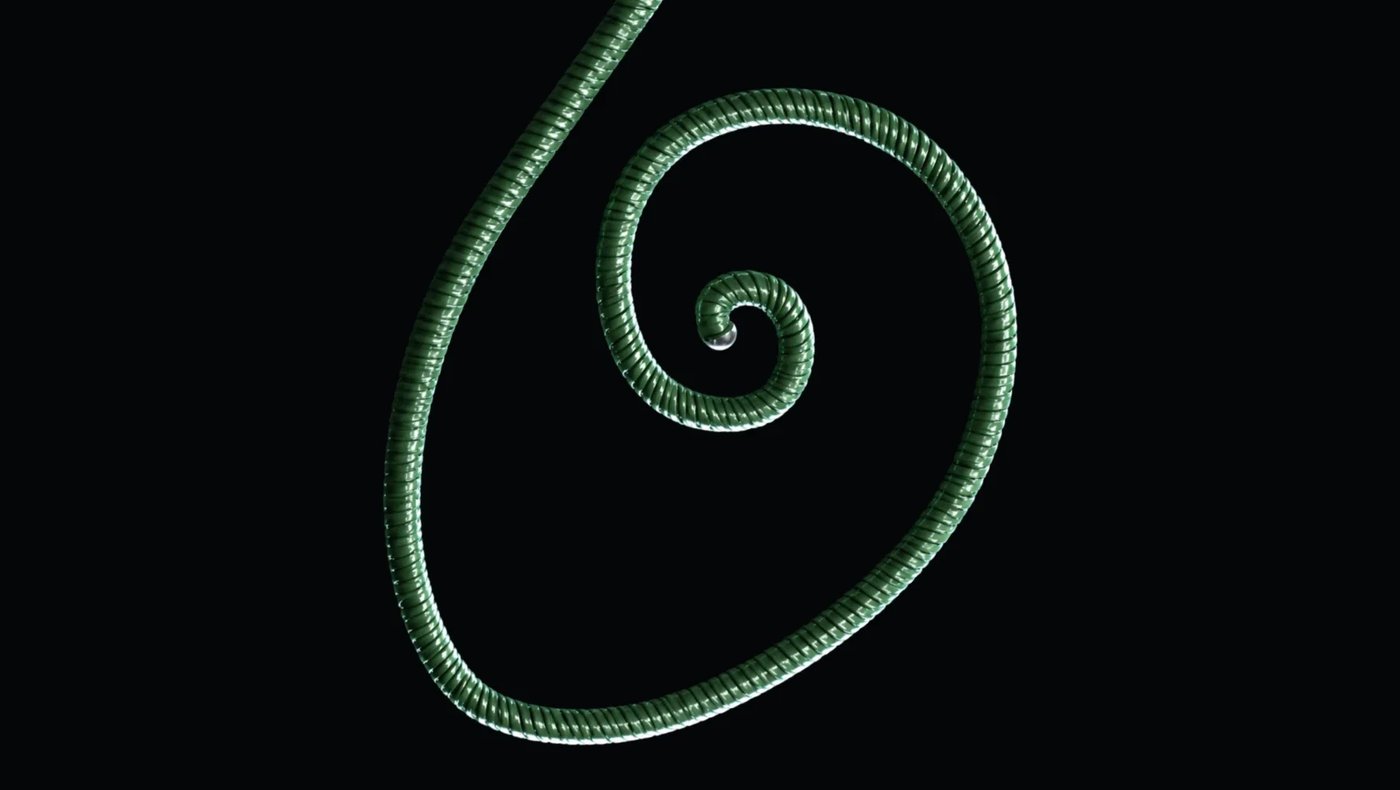
The spiral tip is designed to compress under low force, so it can anchor in the ventricle atraumatically. Paired with a stiff rail, it is designed for an optimal balance of rigidity and soft anchoring.

Source: Draht Medical internal bench testing · Relative values · Not clinical data
The Schwartz™ Wire standing upright: the glossy green shaft rises out of its lavender sheath into a wide arch at the top, then runs down through a steel band and the green coil to the egg-shaped spiral tip at the bottom, on a near-black background. Concept renderings. Not the final device.
04 · Arch

Force absorbed at the arch

The preshaped curve is designed to ride the outer aortic arch and absorb the push of the delivery system there, so less force passes down the wire.

Close-up of the Schwartz™ Wire’s egg-shaped spiral tip: the green coiled wire curves into an open egg-shaped loop that ends in a small inner curl, on a near-black background. Concept renderings. Not the final device.
05 · Apex

Gentle apical contact

With less force passed down the wire, the spiral tip is designed to rest atraumatically at the apex, without concentrating stress on the ventricular wall.

A sterile peel pouch with a printed Draht Medical label reading Schwartz™ Wire, concept prototype, not for clinical use. Inside, the real prototype wire is coiled in its clear dispenser hoop with blue clips; the exposed wire rises from the blue hub over an arch-shaped hook, runs straight down and ends in a small spiral tip. Concept renderings. Not the final device.
06 · Movement

Forward movement at the arch

If the delivery system moves forward unexpectedly, the arch curve is designed to absorb that force, so less of it reaches the myocardium.

Schwartz™ Wire · Concept prototype · Not for clinical useIntended result · In design verification

Concept renderings. Not the final device.

05 — The opportunity

A large and growing market
can now be served by one wire.

$6.2B→ $10.0B
TAVR market, by 2030
8.3% a year
TAVR market growth (CAGR) to 2030
13.3M→ ~19.4M
People worldwide with calcific aortic valve disease, 2021 → projected 2036

What is driving growth

  1. 01An aging population
  2. 02Expanding regulatory approvals
  3. 03Growing acceptance in Europe and Japan
  4. 04Repeat procedures

Sources: Draht Medical market analysis; GBD 2021 via Wang et al., Sci Rep 2025 (13.3M in 2021; modelled projection of ~19.4M by 2036). Calcific aortic valve disease includes all severities. Figures are third-party estimates and will be cited in full.

  • Dependable
  • Predictable
  • Reliable

From our founder

“Clinicians will use what they can confidently control.”
Jonathan Schwartz, MD*Founder · Director of Structural Heart, Atrium Health

06 — Let’s talk

Let's talk.

Tell us a little about yourself and what you'd like to discuss. We'll reply as soon as possible.